A practice log for coding interviews
Solved problems come back. Spaced repetition for the NeetCode 150.
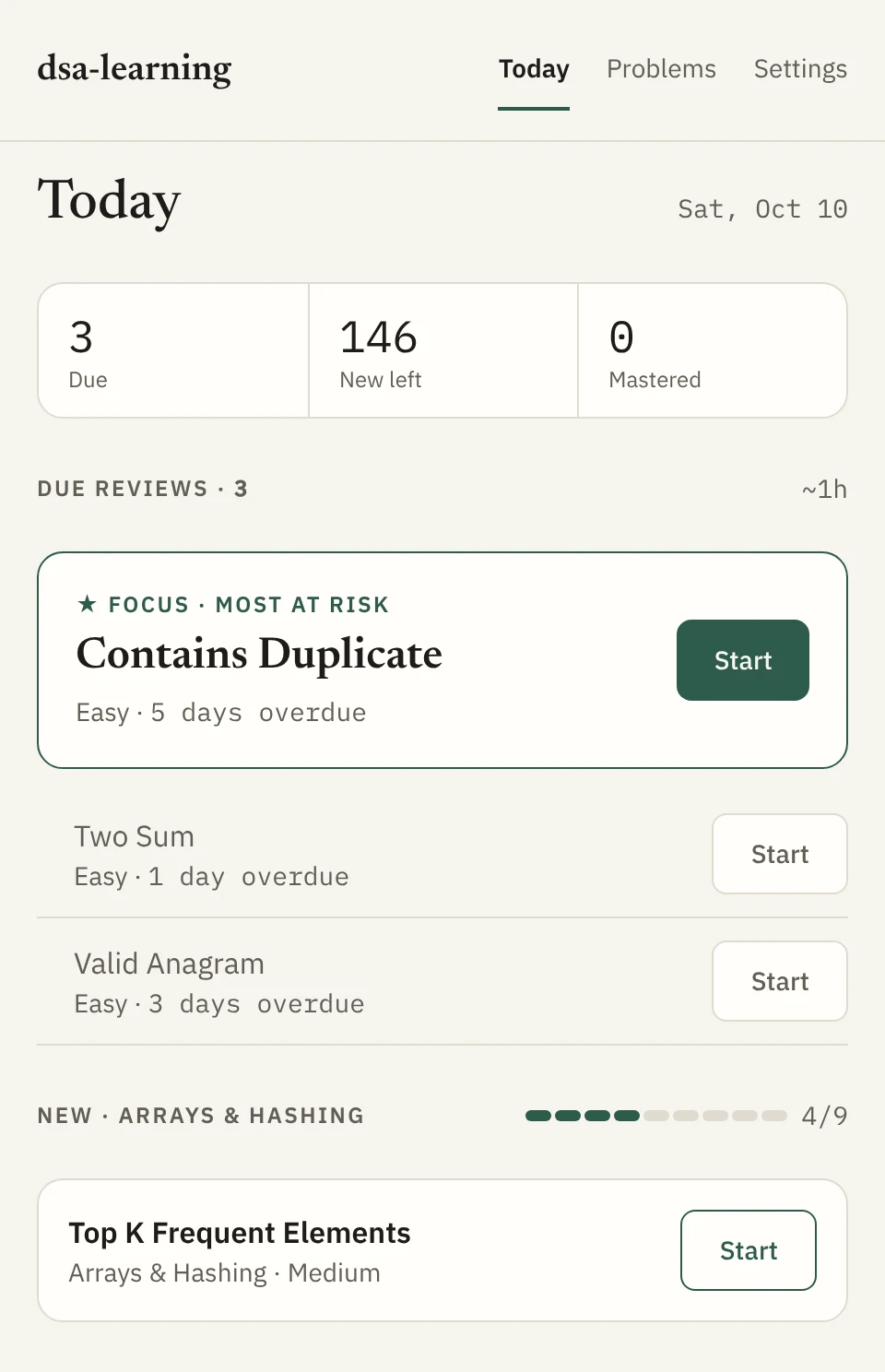
See your due reviews and the next new problem. Solve it, say how it felt, and dsa-learning brings it back for a re-solve: Hard in 2 days, Medium in 7, Easy in 30.
- Free
- No account needed
- Progress stays in your browser
When a problem comes back
Your rating sets the next date. Nothing else does.
The intervals are fixed: a Medium stays at 7 days however often you repeat it. Your time and any help you used are recorded for you to look back on, but they don't change the schedule.
Example: one problem, from first solve to mastered
- Oct 1First solveBack in 2 days
- Oct 3ReviewBack in 7 days
- Oct 10ReviewBack in 30 days
- Nov 9Review, on timeEasy after Easy
- From then onLeaves the rotationMasteredA later Medium or Hard brings it back
The practice loop
Three steps, every day you practice.
See what is due
Today lists your due reviews, most at risk first, plus the next new problem.
Solve and log
Solve it on NeetCode or LeetCode from a blank editor. On reviews, the pattern stays hidden. Then rate how it felt and write one key insight.
Return for a re-solve
Hard comes back in 2 calendar days, Medium in 7 and Easy in 30. Easy twice, on time, and it's mastered.
Why re-solve
Two well-studied ideas, applied to interview prep.
The studies are about learning in general. The exact rules here are our own choices, and the app hasn't been tested in a study of its own.
Read the research notesSpacing
A review spread out from the first study session improved recall later, and the best gap grew with how long the material had to last.
Retrieval
Recalling a passage beat rereading it a week later, even though rereading won on a test five minutes after.
Questions
Before you start
Are data structures and algorithms still important for landing your next job?
For many software engineering roles, yes. Coding interviews at a lot of tech companies still ask you to solve a data structures and algorithms problem live, often in 45 minutes or less, and explain your approach as you go.
They're rarely the only round: system design, behavioral and project discussions usually matter too. But a coding round is often the first filter, so recognizing patterns quickly is worth keeping sharp.
Why re-solve problems I've already solved?
Because solving a problem once doesn't mean you can solve it again weeks later. Recalling an approach from a blank editor, spaced out over days, holds up better than rereading a solution. dsa-learning brings each problem back 2, 7 or 30 days later, depending on how hard it felt.
What is the NeetCode 150?
A list of 150 LeetCode problems grouped by topic, from Arrays & Hashing to Bit Manipulation. dsa-learning follows that list and its topic order for new problems. It's an independent tool, not affiliated with NeetCode.
How many problems should I do a day?
As many as you have time for. Today shows your due reviews first, then one new problem, with a time estimate. There's no daily cap and no streak to protect: you decide how much to do.
Is this a coding platform?
No. dsa-learning tracks your practice. You read the full problem statement and solve it on NeetCode or LeetCode, which may ask for an account of their own.
Do I need an account?
No. Signing in with GitHub is optional and only syncs your progress across devices.
Where is my progress saved?
In this browser: it works without an account, and you can export it as a JSON file and import it again. The Privacy page says exactly what is stored, and where.
Start with problem one.
150 problems, in NeetCode order. Your first review is two to thirty days away.